
Business Wi-Fi projects often look simple from the outside. Buy access points, mount them, connect everything, and move on. In practice, that shortcut is where trouble starts. A professional setup should begin well before deployment, with time spent understanding how people use the space, which devices matter most, where coverage tends to fail, and what the existing network can actually handle. Those early checks shape nearly every decision that follows.
That preparation also gives the business a clearer picture of cost, timing, and risk. A small office with 25 employees may need a straightforward design, while a training floor that fills with 100 devices twice a week is a different story. Same square footage, very different pressure. Before equipment goes up, the team should know what normal use looks like, what peak demand looks like, and where future growth is likely to show up first.
Wi-Fi Site Planning Based on Real Office Use
A professional wifi installation service should start by asking how the office really works. How many people are there? Which rooms fill up? Do employees move around while staying on calls? Those questions sound basic, but they change the design. A quiet executive area and a packed collaboration space should not receive the same treatment just because both sit on the same floor. Wireless planning needs to follow actual use, not neat assumptions.
The site itself deserves a proper walk-through too. Floor plans miss things. Glass partitions, metal storage, thick walls, ceiling limits, and neighboring wireless networks can all affect signal behavior in ways that drawings do not show. A team that checks those conditions early can avoid awkward changes later. It is much easier to move an access point on paper than after cabling is finished and ceiling work has already been closed.
Good Installers Design for Busy Moments
Experienced wifi installers should think about peak demand, not just average demand. The office may feel fine at 9 a.m. and struggle badly at 11:30 when several meeting rooms fill at once. Video calls, cloud apps, phones, tablets, and guest devices can pile onto the same area quickly. A useful design considers those bursts so the network does not fall apart precisely when people need it most today.
Device count matters, but so does device behavior. Ten people checking email create a different load from ten people joining video calls while sharing files. That distinction is easy to miss if the survey only counts heads. A strong team looks at what employees actually do on the network, then plans capacity around that pattern. The result is usually more balanced, with fewer overloaded zones and less wasted equipment in quiet areas.
Access Point Placement Needs Judgment
A second wifi installation service consideration is where access points actually go. Equal spacing may look tidy on a plan, but wireless signals do not follow tidy lines. Walls, doors, furniture, ceiling height, and nearby radios all change the result. Sometimes moving an access point ten feet solves a problem that extra hardware would not. That is why placement should come from measurements, room use, and expected movement rather than convenience alone.
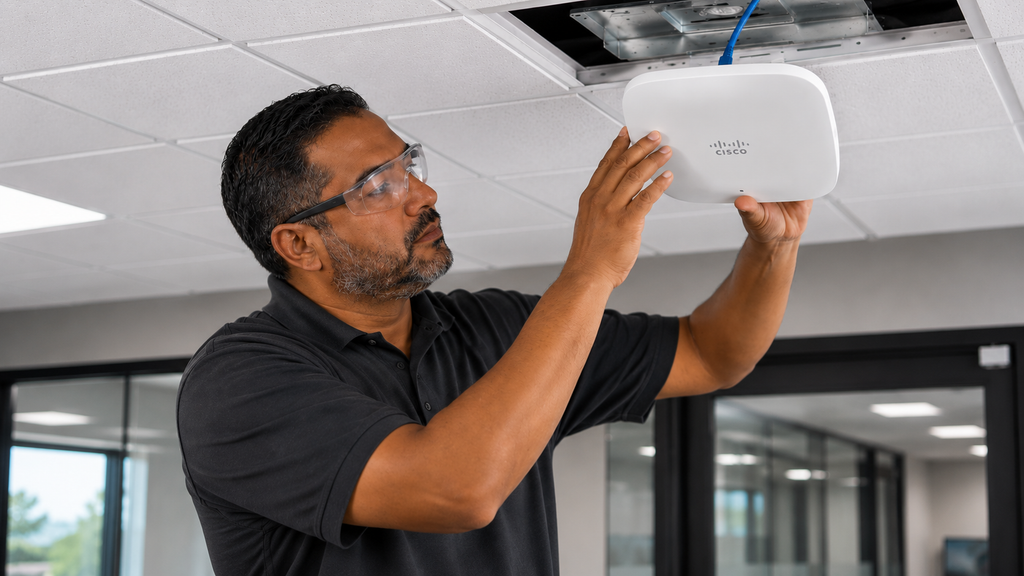
Service access matters too, and this is where practical thinking helps. An access point above a difficult hard ceiling may work perfectly until someone needs to replace it. Then a five-minute task turns into a lift, after-hours scheduling, and extra labor. A slightly different location can often keep coverage strong while making future support far easier. Not glamorous, but useful. Good deployment decisions should still make sense a year after installation.
Wi-Fi Install Security Planning Before Network Launch
Professional wifi installers should also ask who needs access and how much access they actually need. Employees, guests, contractors, and personal devices do not belong in the same trust group by default. Separate wireless networks, sensible authentication, and clear access rules can keep the setup easier to manage. These decisions are much simpler before launch, when only a few test devices are connected, rather than after hundreds of users have settled into bad habits.
Management is part of that conversation. The IT team may need to remove old users, change credentials, review connected devices, or adjust guest access without walking around the building. Central management can make those jobs far less painful. Businesses should know who will control the system, what tools they will have, and how changes are handled later. A network that performs well but is awkward to manage still creates work nobody really wants.
The Wired Network Cannot Be an Afterthought
Wireless hardware still depends on cables, switches, power, and uplinks. If those pieces are already stretched, newer access points may simply expose the next bottleneck. Before deployment, the team should review switch ports, Power over Ethernet capacity, cabling quality, rack space, and uplink speed. Otherwise, the business can end up with stronger signal bars but little real improvement in performance. That is a frustrating result, especially after spending on new equipment.
Consider a growing office adding eight access points for a new department. The wireless design may be solid, yet older switches might not provide enough power or bandwidth for all eight. Suddenly the project needs extra hardware and another change window. That delay was avoidable. Checking the wired side early gives the business a more honest budget and helps everyone understand whether the job is truly a Wi-Fi upgrade or a broader network upgrade.
Testing Should Feel Like a Real Workday

Pre-deployment testing should resemble the conditions the network will face after launch. Quiet rooms are not enough. Teams should check signal quality, speed, roaming, and connection stability in meeting areas, corridors, reception spaces, work zones, and other busy locations too. When possible, they should also test during heavier activity. A wireless setup can look excellent in an empty office and behave very differently once 150 people arrive with multiple devices.
The final results should be recorded in a form the business can actually use. Access point locations, test readings, settings, and any last-minute changes create a helpful baseline. Six months later, if one conference room starts generating complaints after a remodel, technicians can compare new readings with the original data. That shortens the search. Instead of questioning the whole network, they can focus on what changed and why performance moved with it.
Conclusion
A professional Wi-Fi project should feel deliberate before anyone starts mounting hardware. Businesses should expect questions, site checks, capacity planning, thoughtful placement, a review of the wired network, sensible security decisions, and testing that reflects real use. Some of that work happens quietly in the background, but it matters. When the preparation is done well, deployment becomes less about fixing surprises and more about putting an already-tested plan into place.
CMC communications can help commercial teams approach Wi-Fi deployment with that kind of practical preparation in mind. Their involvement can support clearer planning around coverage, device demand, cabling, access points, and future changes before the network goes live. For businesses, that means fewer rushed decisions and a better chance of ending up with wireless infrastructure that is easier to manage, troubleshoot, and expand as daily technology needs keep changing overall.
Frequently Asked Questions
Question: What information should a business share before a Wi-Fi site survey?
Answer: Staff numbers, device types, floor plans, busy rooms, guest use, and known connection problems are all useful. It also helps to explain when demand peaks. A training room that fills twice a week may need more attention than its normal daily use would suggest.
Question: Why should the wired network be checked before deployment?
Answer: Access points still depend on switches, cabling, power, and uplinks. If those systems are already near their limits, new wireless hardware may not improve real performance. Checking them early can prevent a Wi-Fi project from simply moving the bottleneck somewhere else.
Question: How do businesses know how many access points they need?
Answer: There is no reliable one-size-fits-all number. Building materials, room layout, device density, interference, user movement, and application demand all matter. A survey and capacity review give a much better answer than dividing square footage by a standard access point count.
Question: Should guest Wi-Fi be separate from employee Wi-Fi?
Answer: In many commercial spaces, yes. Guests and personal devices usually do not need the same access as employees or business systems. Separating them can make security and management easier while still giving visitors the internet connection they need.
Question: When should Wi-Fi be tested again after launch?
Answer: Retesting makes sense after major renovations, department moves, staff growth, new equipment, or repeated complaints. Those changes can alter both signal behavior and traffic. Comparing fresh readings with the original baseline helps technicians find the real cause faster.